
Fractional Integrator vs. Fractional COO vs. Operations Manager: Which Does Your Business Need?
If you've been looking for operational help in your business, you've probably come across all three of these titles and wondered what the actual difference is.
Fractional integrator. Fractional COO. Operations manager.
They all sound like they "do operations." They all work with teams. They all promise to take things off the founder's plate. But they're not interchangeable, and hiring the wrong one for your business stage is an expensive way to find that out.
Here's what each role actually does, how they compare directly, and how to figure out which one your business needs right now.
Why These Roles Get Confused
The confusion is understandable. In smaller companies, one person often plays all three roles, or a version of all three. Titles get applied inconsistently. Someone is called an "operations manager" but is really doing integrator-level work. Someone is hired as a "fractional COO" when what the business actually needed was a fractional integrator.
The market doesn't help. These titles are used loosely, and most definitions are either too vague ("they handle operations") or too narrow ("they manage projects").
The clearest way to separate them is by asking three questions: What level do they operate at? What are they specifically accountable for? And at what stage of business do they create the most value?
What Does an Operations Manager Do?
An operations manager owns a functional area of the business. They manage processes, systems, and often a team within a defined scope: delivery, logistics, client success, or another specific function.
Their job is to make their department run well. They're executing within boundaries that someone else has set. They report to a COO, a fractional integrator, or directly to the founder when no operational leadership layer exists above them.
The operations manager is excellent within their domain. But they're not accountable for the operating health of the whole business. They're not coordinating across all departments. They're not the person who makes sure the company as a whole is moving in the right direction.
What an operations manager is responsible for:
Managing a specific team or function
Maintaining processes within their scope
Reporting on their area's performance
Executing against priorities set by leadership
What an operations manager is not responsible for:
Cross-functional coordination
Business-wide operating rhythms
Founder-level accountability structures
Strategic execution across the whole business
When a founder hires an operations manager hoping it will remove them from the operational center of the business, it usually doesn't work. The operations manager solves one piece, not the whole structural problem.
What Does a Fractional Integrator Do?
A fractional integrator operates at the leadership level, across the whole business, embedded inside the company without the cost of a full-time executive hire.
Their job is to be the operational right hand to the founder: translating vision into coordinated execution, creating accountability across functions, building the operating rhythms that make the business run reliably, and removing the founder from the middle of day-to-day decision-making.
This is a fundamentally different orientation than an operations manager. The fractional integrator doesn't own one department. They own the operating health of the whole business. They coordinate across marketing, sales, delivery, and client success. They hold the team accountable to outcomes, not just tasks. And they create the structure that makes the business less dependent on the founder over time.
For a deeper breakdown of what the role covers day-to-day, read what an integrator actually does in a business.
What a fractional integrator is responsible for:
Cross-functional coordination across all departments
Building and maintaining operating rhythms (weekly, monthly, quarterly)
Creating accountability structures for the whole team
Translating the founder's vision into an executable plan
Removing the founder as the operational bottleneck
Resolving cross-functional issues before they escalate
What a fractional integrator is not:
A project manager (they own the operating system, not individual projects)
A fractional COO (they operate at integration level, not executive strategy level)
A consultant (they're embedded, not advisory)
The fractional integrator model exists because most founder-led businesses don't need a full-time executive to solve their operational problem. They need consistent, senior-level integration work, embedded inside the business, without the overhead of a six-figure salary.
What Does a Fractional COO Do?
A fractional COO operates at the executive level. They're responsible for the company's overall operational strategy: not just execution, but the strategic decisions about how the business runs, scales, and grows.
The fractional COO sits in the C-suite. They report to the CEO, represent operations at the board or investor level, and often carry P&L accountability alongside the founder. They're thinking about operational infrastructure across a more complex organization: multiple service lines, significant headcount, and revenue at a stage where strategic operational decisions have major consequences.
The fractional COO and the fractional integrator overlap in some ways. Both work across the whole business. Both coordinate execution. But they sit at different levels of the organization and serve different business stages.
What a fractional COO is responsible for:
Executive-level operational strategy
P&L accountability alongside the CEO
Representing operations at board and investor level
Scaling operational infrastructure across a complex organization
Setting operational vision, not just executing it
The clearest distinction: the fractional COO builds and leads the operational strategy. The fractional integrator executes it. In larger organizations, both roles exist. In a founder-led business that isn't yet at COO stage, bringing in a fractional COO often means paying for executive capacity the business isn't complex enough to use.
Side-by-Side Comparison
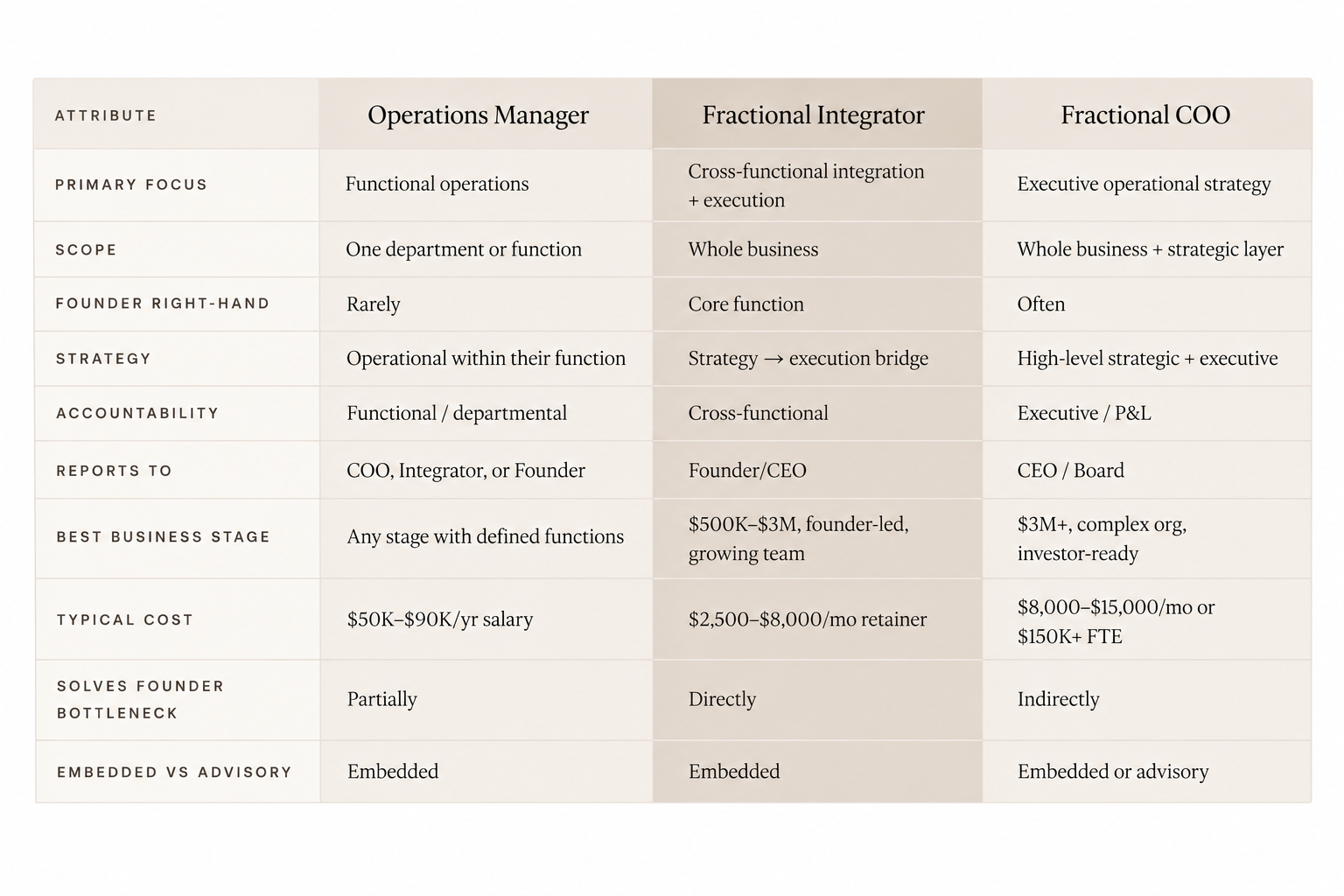
Which One Does Your Business Actually Need?
You need an Operations Manager if: You have a specific functional area that needs dedicated leadership or process ownership. Your delivery team is growing and needs a manager. You already have operational coordination happening at the leadership level, and this hire fills a specific functional gap, not the whole operational leadership role.
You need a Fractional Integrator if: You're the operational bottleneck in your business. Your team is capable but not coordinated. Decisions still route through you. Projects slip without your involvement. You want to step back from the operational center but the business doesn't have the structure to let you. You're generating $500K to $3M in revenue and growth keeps creating more work for you instead of less. You need senior operational leadership embedded in the business, but a full-time executive hire isn't the right move yet.
You need a Fractional COO if: Your business is at a stage where operational decisions carry significant strategic weight. You have $3M or more in revenue, meaningful complexity across multiple service lines or teams, and you need someone who can think and communicate at the executive level, with investors, a board, or a senior leadership team. You already have operational infrastructure. What you need is executive leadership over it.
Most founder-led businesses in the $500K to $3M range who are searching for operational help are describing a fractional integrator problem, even when they're searching for a fractional COO.
If you're still figuring out whether you're actually ready for this kind of hire, the eight signs your business needs a fractional integrator is worth reading before you make a decision.
The Real Reason This Decision Matters
Here's what most founders don't say out loud when they start looking for operational help.
It's not just that things are chaotic. It's that they've built something real, something that works, something that generates revenue and serves clients. And they're still the one who has to show up every day to hold it together.
They wanted to build a business. They built a job that requires them in the center of it.
That's not a hiring problem. It's a structural one. And getting the wrong role into that structure doesn't fix it. It adds another person to a business that was never designed to run without the founder in the middle.
The right hire for the right problem is what changes the structure. Not just the staffing.
Frequently Asked Questions
What's the main difference between a fractional integrator and a fractional COO? The fractional integrator sits at the execution layer: their job is to turn strategy into coordinated action, build operating rhythms, and remove the founder as the operational bottleneck. The fractional COO sits at the executive layer: they own operational strategy, often carry P&L accountability, and are right for businesses with more complexity and a higher revenue base. In a smaller founder-led business, the fractional integrator solves the actual problem most founders are facing.
Is a fractional integrator the same as a fractional COO? Not exactly, though the terms are sometimes used interchangeably. A fractional COO typically operates at a higher strategic and executive level. A fractional integrator is specifically focused on cross-functional coordination and execution: the operational middle between the founder's vision and the team's work. For most founder-led businesses under $3M in revenue, the fractional integrator engagement addresses the real problem more directly.
When should a business hire an operations manager vs a fractional integrator? Hire an operations manager when you have a specific functional area that needs dedicated leadership. Hire a fractional integrator when the core problem is that you, the founder, are still the operational center of the whole business: the decision-maker, the bridge between departments, the person holding all the threads. The operations manager solves a departmental problem. The fractional integrator solves a founder dependency problem.
How much does a fractional integrator cost compared to a fractional COO? Fractional integrators typically work on retainer, ranging from $2,500 to $8,000 per month depending on scope and involvement. Fractional COOs typically range from $8,000 to $15,000 or more per month. A full-time COO hire runs $150,000 to $200,000 or more annually. For businesses at the $500K to $3M stage, a fractional integrator delivers the operational leadership impact at a cost that matches the business's stage.
Can a small business afford a fractional integrator? Yes. The fractional model exists specifically to make senior operational leadership accessible to founder-led businesses that aren't yet at the size to justify a full-time hire. Most founder-led businesses in the $500K to $2M range generate enough complexity to need an integrator, but not enough to sustain a six-figure executive salary. The fractional engagement bridges that gap.
Ready to Talk About What Your Business Actually Needs?
If you've read this far, you're probably past the research phase. You know you have an operational problem. You're just not sure exactly what to do about it.
That's what a conversation is for. Book a call here.